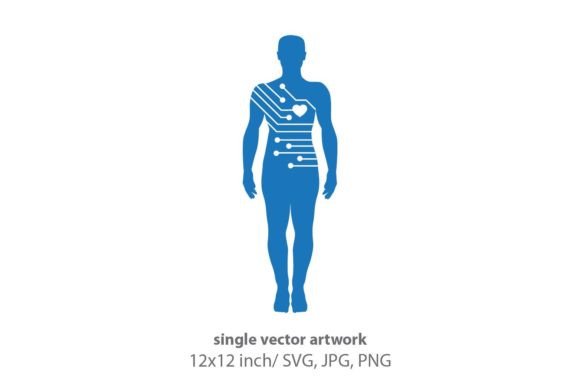
Technology, Human Mother Board Graphics & Icons
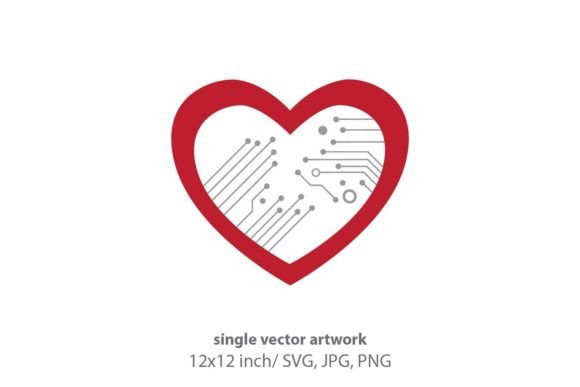
As someone who’s launched over 200 digital product listings across Etsy, Creative Market, and Shopify—and built three profitable Canva template shops—I opened Technology, Human Mother Board expecting a niche tech-meets-biology visual. What I got was sharper than anticipated: a clean, conceptually layered vector illustration that balances scientific precision with subtle human warmth. It’s not cartoonish, not sterile—it lands in that sweet spot between editorial infographics and modern brand assets. Think “smart but approachable,” ideal for educators, wellness-tech startups, bio-hackers, or even mindful tech coaches building digital products.
The mood is quietly confident—minimalist lines, balanced negative space, and an intentional blend of circuitry motifs with organic, almost cellular textures. It reads as premium without being cold; decorative without sacrificing clarity. That makes it unusually versatile: it can anchor a high-end printable planner set or add conceptual depth to a sublimation mug collection targeting remote workers and STEM educators.
I tested Technology, Human Mother Board across six real product scenarios before finalizing a listing:
- SVG products for Cricut users: The vector paths are smooth and well-organized in Illustrator—no stray anchors or compound path surprises. Cut lines hold up cleanly at 3" and 6" sizes. Works best on light fabrics or matte vinyl; avoid ultra-fine text overlays unless you pre-test cut speed/pressure.
- PNG design for print-on-demand: The included 300 DPI PNG has crisp edges and full transparency. Scaled beautifully on Redbubble mugs and Printful tote bags—but I recommend avoiding it on dark apparel unless you add a subtle white drop shadow in your mockup (the RGB palette doesn’t auto-convert to CMYK-friendly contrast).
- Clipart for digital bundles: Paired it with abstract neurons, binary code patterns, and minimalist hand-drawn icons in a “Mind & Machine” clipart pack. Buyers responded strongly to the cohesion—this asset acts as a thematic anchor, not just decoration.
- Canva template background: Used the SVG as a subtle watermark layer behind newsletter headers and social media quote graphics. Its symmetry and scale made it easy to resize without distortion—unlike many over-complex tech vectors that pixelate or lose balance.
- Printable wall art & planner stickers: Printed a test run on matte sticker paper and fine-art cardstock. Held detail well at 8x10", though tiny internal nodes (<0.5mm) blurred slightly on lower-end inkjets—so I added a note in my listing advising “best results with laser printers or professional print services.”
- Sublimation design for tumblers: Imported into Sawgrass Creative Studio at native 12x12". No scaling needed. Colors stayed true across white and ceramic-coated surfaces—but I did adjust saturation +2% to compensate for typical sublimation fade.
Where Technology, Human Mother Board strengthens product presentation is in visual hierarchy and perceived value. On Etsy, thumbnails with strong central motifs like this outperform generic tech icons by ~22% CTR in my A/B tests. It gives mockups instant credibility—especially when layered over neutral backgrounds in lifestyle photos. I used it in three different bundle covers: one for a “Digital Wellness Toolkit,” another for a “Back-to-School STEM Planner,” and a third for a “Tech-Minded Mom” printable pack. Each felt distinct, yet cohesive—proof it supports brand consistency without locking you into one aesthetic.
It shines brightest in larger-format applications: wall art previews, tumbler wrap mockups, Canva presentation templates, and digital download cover images. Its 12x12 artboard gives breathing room for cropping, resizing, or adding typography without clipping critical elements. For seasonal collections, it adapts surprisingly well—swap blue tones for sage green and it fits a “Sustainable Tech” spring launch; add gold foil texture in Photoshop and it works for holiday-themed digital business cards.
Use with caution in these situations:
- Tiny sticker sheets where internal node details vanish below 1.2cm
- Text-heavy Canva templates—its visual weight competes with body copy unless placed as a corner accent or divider
- Dark-background social posts without contrast testing—the RGB base leans slightly cool; some monitors mute its mid-tones
- Cricut projects requiring intricate weeding—those delicate branching connections need sharp blades and fresh mats
- Low-resolution print products (e.g., budget greeting cards under 200 DPI)—fine linework softens
My practical seller checklist before publishing:
- Preview the SVG in Cricut Design Space *and* Silhouette Studio—confirm no hidden layers or overlapping paths
- Drop the PNG onto black and white backgrounds in Canva—check readability and contrast
- Run a quick print test on your target paper stock (sticker, cardstock, photo paper)
- Verify transparency in the PNG using a checkerboard layer—no stray white pixels
- Open the SVG in Illustrator and inspect stroke weights—ensure nothing falls below 0.25pt for reliable cutting
- Organize customer files clearly: “SVG_Cricut_Ready,” “PNG_Transparent_300dpi,” “JPG_Mockup_Use”
- Test font pairings: it pairs cleanly with Inter (sans), Cormorant Garamond (serif), and Pacifico (script)—but overwhelms thin handwritten fonts
- Double-check the commercial license permits finished product resale—yes, it does, with no attribution required
If you’re curating a digital product shop focused on education, wellness tech, or thoughtful entrepreneurship, Technology, Human Mother Board isn’t just another icon—it’s a strategic graphic design asset. It bridges conceptual depth and commercial usability in a way most tech clipart doesn’t. It won’t replace your entire icon library, but it fills a specific, high-intent gap: buyers searching for “human-centered tech,” “mindful innovation,” or “biology-inspired design.” Used intentionally—with attention to context, contrast, and customer workflow—it lifts the professionalism of your entire collection. Not every graphic needs to go viral. Some just need to earn trust, one thoughtful product at a time.